

Wellness at work: Exploring professional vulnerability at MSU
March 19, 2026 - Micaela Flores and Deborah J. Johnson, Ph.D.
On Feb. 11, 2026, the Diversity Research Network, or DRN, hosted a hybrid session in collaboration with Dr. Joseph Hamm, associate professor in the School of Criminal Justice and Environmental Science and Policy Program. The event, "Wellness at Work: Navigating Professional Vulnerability at MSU – Insights from Trust Research," presented by Hamm, explored the role of professional vulnerability and trust in shaping workplace wellness, and brought together faculty from a wide range of disciplines creating of rich space for dialogue, reflection and shared learning.
Hamm's presentation centered on the role of professional vulnerability and trust in shaping workplace wellness for individuals and within organizational culture. Drawing on current research in trust across disciplines, he introduced a new shared language to understand how faculty experience vulnerability as they navigate institutional policies, evaluation structures and broader socio-political dynamics. Early career faculty often feel good about their academic roles, but experience critical work stresses, teaching overloads, isolation and sometimes work-family imbalances driven by productivity pressures. Hamm argued that embracing vulnerability in situations where individuals are equipped to manage it is often necessary for improving how and where structural support is ultimately available. His findings indicate that feeling exposed, supported or at-risk shapes trust between colleagues, leadership and institutions.
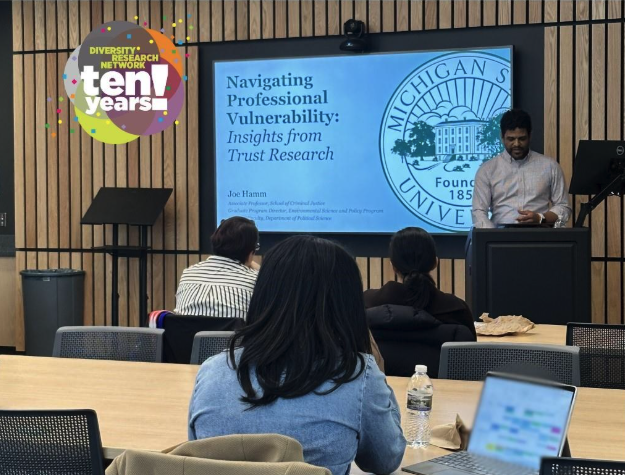
Following the presentation, discussion among attendees focused on how vulnerability is reflected in their own professional experiences and what it means to feel exposed or at risk within academic environments. Hamm emphasized that vulnerability is not a weakness but a critical component of building stronger relationships and healthier organizational cultures.
The session promoted the importance of open dialogue, research informed approaches, and cross-disciplinary community-building in advancing a healthier, more inclusive workplace at MSU and further advances the DRN’s commitment to creating spaces for connection that support faculty well-being and strengthen our broader academic community.
The faculty vulnerability project operates under a collaborative partnership led by Hamm. His team brings together Bill Chopik, associate professor of psychology; Karen Holt, associate professor in the School of Criminal Justice; the DRN; and the MSU provost's office to better understand and address faculty vulnerability with the ultimate goal of promoting resilience on campus.